maandag 24 november 2014

All feedback

Feedback week 1 (19-9): Friedman & IE puzzle

Sander van Nielen

I could not reply on your first two blogs, so therefore you can find my feedback below.

On your blog called “Sustainable Business”:
You have chosen a quite interesting phenomenon, the higher stock of sustainable businesses. You have a very pleasant way of writing!

What do you exactly mean by ‘confidence’ in your first argument? Do you mean those businesses are less likely to go bankrupt? Or do you assume those companies are more transparent towards the investors, shareholders and banks? Because interesting thing is that those companies do not necessarily make more profit, compared to non-sustainable businesses.
You conclude the argument by stating that sustainable companies have to be comparable to non-sustainable companies, but I believe the point of the sustainable is that they want to differ: they produce the same service or product, yes, but the management is supposed to be different, right?

Your second argument is very plausible, but you leave out all the smaller, younger sustainable companies that enter a market of (almost) perfect competition, like biological coffee for example. It is not the case that no company like that ever enters a market (of course for a market of less competition it is easier to maintain and therefore your argument holds). I am wondering how you can explain those businesses.

I could not agree more on the third argument!

On your blog called “The business of business”:
I agree on your reasoning that a manager makes decision in favor of the company he is paid for to do.

It is amusing to notice the turning point you apparently have made between the first and the second blog. In the first you defend that sustainable companies (I assume those are managed by CEO’s that have a sustainable mindset) have higher stocks, and in this blog you reason that ‘environmental friendly’ businesses will be competed out by conventional businesses.
I am wondering, what is your actual point of view about this? :)

Your solution for the ‘problem’ of environmental businesses is a task for politicians and consumers. You explain both sides very well and clear. I personal side note: if your first point is true, that environmental businesses are not self-supportive, isn’t that also caused by consumers? We prefer cheap over sustainable, so in fact consumers are responsible for the problem of environmental companies. Ofcouse, I agree that if the problem is solved, consumers start buying more expensive, responsible product, consumers are also the solution.

Your final conclusion was really nice!

Ilonka Marselis

First of all, I really appreciated the general introduction to your blog about the black background :)!
Is it true that I missed your second blog about “the business of business is to increase it’s profits”?

You have a very clear and profound introduction to the first blog.

Your first explanation is a very strong one. It was not the exercise, but I am just wondering if you think the free market could overcome this problem by itself?

I agree on your second argument about the little transparency of products. But don’t you think it can be a responsibility of a consumer in a free market to address different products and their production chains? And if they do not address them, the cheaper price of ‘conventional’ products is preferred by them, above the sustainable production chain?
…Which is the exact point you make in the third argument I see!

Not much more feedback can I give on your blog, even though I do not agree with your conclusion, but that is just a difference of opinion :).

Feedback week 2 (2-10): Newsitem on rational decisionmaking & development Friedman Proposition

Tim de Vrijer

-

Paulina Criollo

Thanks for writing your blog, my apologies for the late comments.

On the first part of the blog:
The outlook with the picture is well done! Also, my compliments on the topic you have chosen, it is not very obviously. I have no comments on the content of your blog, good job!
My only comment is that you could try to write more like a journalist, so your blog is more of an article than an assignment for a course. That makes it more ‘fun’ to read.

On the second part:
You have nice, funded arguments. Your English is very well, making this complex subject more understandable. Your arguments are build straight-to-the-point, which I consider to be an important skill.
My first comment is again the feeling I get after reading that you have not been able to leave the scholastic aspect of the assignment and write the blog like an article. You could elaborate about the video, for readers that haven’t watched id for example.
My second comment is that I miss out on the development of your proposition about Friedman. Maybe you can add how one argument resulted from the other and if you have switched “sides” one time, apart from a summary of last week’s assignment.

Thanks again!

Feedback week 3 (9-10): Ostrom's SES and Friedman

Rebecca Joubert

-

Hsiu-Chuan Lin

Q 1- I liked your blog a lot, the lay-out with pictures and clear structure of the titles of the assignment was nice. I appreciated your introduction about the framework and the settings of the coffee market. I also liked your argumentation, especially the extra work you have done in the paragraph about the Tragedy of the Commons.

Not many tips, only the point that your blog was very long. Maybe you could cut it a little short?

Q2 - Thanks for writing this blog. The lenght and to-the-point argumentation is better than the previous. I like your citation too.
One point of feedback: in the first part you talk about the government enforcing rules. Friedman is against governments imposing rules right? And how can local farmers make others distribute resources? Those diffences result from an inefficient market I believe, making it not nessecary to distribute, because that will support the existence of an inefficient market. What is your opinion?

Feedback week 4 (16-10): Nokia Video

Romée de Blois

Thanks for writing your blog, my apologies for the delay of my feedback.

Your explanation of the video in the beginning is well done, especially for readers that haven't seen the video. Your argumentation is also very clear, maybe you could add some more arguments, apart from the ones that defend your point of view, that attack arguments against your point of view?
Your blog has a nice lenght, not too long and not too short: all the information needed is present, well done!
Could you elaborate a little more on the legitimacy of the supplier in the video? Your explanation on the legitimacy of Nokia is very well done!
Could you be a little more 'to-the-point' in the last part about a coördination mechanism? The one you propose is more governmental regulation, what regulation do you mean? Regulation in developed countries where the products are sold, or regulation in China? And how can this be achieved?
The blog looks and reads still like a 'school assignment' instead of an article or blog. Maybe you could write the questions that had to be answered more in a story instead of the dots.

I have some comments, but overall your blog was really good!

Vigil Yu

Thanks for writing your blog, my apologies for the late reply.

Your blog is actually a blog (instead of a school assignment) well done! The introduction, consisting of a summary of the Nokia Documentary, is a good addition.
Also very nice you have used your own experiences of growing up in China, that makes it even more interesting to read.
You have a very strong way of argumenting and your English language proficiency is clearly at a high level, which convinces a reader to agree with you.

The only thing I missed was the part where you describe a new coördinating mechanism. I think you try to do that in the last two paragraphs, but could elaborate a bit more on that, mainly about the practical implication of such a system.
One point of critique is the length of the article. Even though it was very interesting to read all of it, you could try to be a little shorter in your argumentation.

Thanks again, it was a pleasure to read!

Feedback week 5 (23-10): Regio networks, linkages and constraints

Jorinde Vernooij

Thanks for writing your blog, my apologies for my late reply. You have chosen an interesting subject, and the questions in the introduction make me cutious to read further. It is a real blog, not just a school assignment, well done! Nice visualisation of the network you have made in figure 1.
I could not open your second figure about material exchange, which is a pity.
Maybe you could try to implement your own opinion about this case, since your blog is not too long.

Thanks again!

Rens van de Peppel

-

Feedback week 6 (6-11): Harvest game

Milan Veselinov


-

Franco Donati

-

Feedback week 7 (13-11): External control and LCAs

Zev Starmans

-

Paulina Gual

-

Feedback week 8 (20-11): Evolutionary game

Wybren Brouwer

-

Alice van Rixel

Thanks for writing your blog, explaining how the evolutionary game works. You have explained it very clear to my opinion (but I was in your group so I know exactly what game you are explaining, what makes me a little biased of course) and also structured it nicely. 
The conclusion on that to learn from this blog is a nice addition too!
My only comment is that you could try to write it a bit more like an actual article or blog, instead of an assignment for a course, by leaving out the word 'assignment' and assuming that the reader has no idea why you write this and what happened in class. 

Thanks again and good luck!

woensdag 19 november 2014

Blog 20-11

The task for last week’s class was designing a game that would include an evolutionary process, including the key elements of Darwin’s theory: variation, selection and reproduction.

The game my group (#3) and I designed, starts by dividing the class in a few groups, say over 5, and one person is the omniscient narrator, like a bank.
Each group is a firm, producing a product with 3 characteristics that have 3 types of variation:
1.       Size: small, medium or large;
2.       Color: red, blue or yellow;
3.       Shape: square, triangle or circle.

In advance, the so called bank will assign values to all variations of the characteristics. Assume that profit = quantity, so price = 1 unit of money. For example:
1.       Size: small (30), medium (10) or large (20);
2.       Color: red (10), blue (20) or yellow (30);
3.       Shape: square (20), triangle (30) or circle (10).
This results in an optimal product preference, in the example above the consumer preference will be a yellow, small triangle.

The game will run in rounds, every round a firm has to state what kind of product it will produce, using the 3 characteristics. On a big screen in class, the choices of product of every firm will be shown, so all the firms know after the round what each firm has produced and earned according to the consumer preference.
In that case, firms will try to find out what the main consumer preference is, according to information about the production of other firms. That is the main goal of the game: a firm has won when it has produced a product that makes it gain/produce 90 units.

An important part in the game is that a firm needs to survive too, by setting a minimum of earnings/production of 50 units. In the example above, a firm producing a medium, red circle for example, will go bankrupt because it will only earn/produce 40 units. The same holds for a firm producing a medium, red square (40 units). But a firm producing small, blue circle for example, will live because it will earn/produce 60 units.

When the first round is finished, the firms can see on the screen whether they still live and what the other firms tried to produce to survive or even win the game. In that way, the firms can compare their choices of characteristics and adjust to each other. In the next round the firms will state their choice of characteristics again, in a different setting than before if they did not gain or produce 90 units.

In this way, variation is part of the game because changing the setting of characteristics every round.
Selection is integrated because of the information about the production of other firms will influence the behavior of firms to copy others. Therefore an optimal set of characteristics is selected every round by the surviving firms.

Reproduction is present because of the copying of other’s sets of characteristics. 

woensdag 12 november 2014

External control and LCAs (13-11)

Life Cycle Analysis is a technique that integrates resource use, energy input and waste production from all processes related to the production of goods and services, ‘from the cradle to the grave’ ( (Boersema & Reijnders, 2009). The result of this analysis is a method to assess the environmental impact of products and services.
External control is a system outside society, regulating that society. The most common example of an externally controlling system is the government setting rules. Those rules are setting boundary conditions for the self-organisation of the specific goal the government had in mind when creating and implementing that rule.
The goal of this blog is to come up with four ways for a government to increase use of LCAs by setting boundary conditions and external control, according to the framework of Sabatier (1980), presented below.
Figure 1: Sabatiers Framework (Sabatier, P., & Mazmanian, D.  1980)
Sabatier’s framework presents the stages of the implementation process of a policy and 3 main variables influencing that process: the tractability of the problem, the ability of statute to structure implementation and the non-statuary variables affecting implementation.

I feel that external control is enforcing a ‘top down’ increase of use, while I feel that providing boundary conditions is creating a ‘bottom up’ development. Therefore I have come up with two examples for external control and two examples of setting boundary conditions, because my hypothesis is that this difference in development might give different results. My explanation for this possible outcome is that enforcing rules might rule out potential innovators (sidenote: I am aware that this hypothesis is influenced by my own liberal view, therefore I feel it is even more interesting to investigate it).
Shortly, the four ways the government can increase the use of LCAs through external control and setting boundary conditions are:
-          making LCA theory part of the course materials in high schools (external control)
-          the requirement of using an LCA when implementing a governmental policy (external control)
-          providing subsidy to companies that make use of LCAs in their operations (setting boundary conditions)
-          investing in research that is aiming to improve the LCA method (setting boundary conditions)

Based to the Sabatier framework, for both measures that make use of external control analysed by the traceability variable, some problems might occur regarding the extend of behaviour change and the percentage of the target group regarding the population. Policy makers in implementing agencies have to extend their procedures if they have not been using LCAs and teachers have to learn about the theory, if they have not done so far, to be able to teach it to students. Assuming that around 1 million people work for the Dutch government (Rijksoverheid, 2013), the target group is around 6% of the entire population. Depending whether one considers this a large part or not, it might give difficulties in implementing or not. The theory and technology about LCAs is available so that might facilitate the use of those measures.
Compared to the two measures that set boundary conditions, it might be more difficult to access the available theory and technology. The target group and the behavioural change required for those measures are larger compared to the external controlling regulations, because not only policy makers are involved and changing behaviour, but the private sector too. But the behavioural change is voluntarily and therefore the behavioural change might be less.
                Therefore the effectiveness of external control, regarding the traceability variable, is larger compared to the other option of setting boundary conditions.

When analysing the two kinds of measures, external control and setting boundary conditions, based on the statutory variable, the unambiguousness of policy directives might be less effective in the case of boundary conditions due to the sensitivity of lobbying. Also the financial resources required might be larger for the boundary conditions, because of new subsidies and investments. The decision rules for implementing agencies have less money at stake in the external control measures, I believe.
But the formal access by outsiders is easier for the boundaries measure, because of the communication that is facilitated in this case. The incorporation of adequate causal theory might be more efficient for the boundary measures, due to the incentive of financial support.
Therefore the effectiveness of external control, regarding the statutory variable might be larger compared to the setting boundaries measures.

The effectiveness of the non-statutory variable is in favour of the setting boundaries measures, during the stages of implementation.
The media attention might be larger for the external control because more people will learn about LCAs.
The attitudes and resources of the groups might be better in the setting boundaries measures, because of the free choice. The same holds for the socio-economic conditions and technology, because of the incentive to receive support. Because of the free choice, the public support might also be larger.

                Overall, the potential effectiveness of external control is larger than I had expected in the first place. This is based on the analysis of the measures using the framework of Sabatier.


References

Boersema, J. & Reijnders, L., 2009. Principles of Environmental Science. Amsterdam: Springer Science; Business Media B.V.
Rijksoverheid, 2013. www.rijksoverheid.nl. [Online]
Available at: http://www.rijksoverheid.nl/nieuws/2013/06/05/cijfers-overheid-steeds-kleiner.html
[Geopend 12 11 2014].


dinsdag 4 november 2014

Harvest game

In the previous class, a game called “the Harvest Game” was played. In this game, the class was divided into 6 groups of students. Every group represented a boat on a fictive ocean, containing 50 fish. Each boat was fishing in this ocean, trying to maximize its profits. The element of time in this game was represented by a ‘round’ where every team had to determine how much they were going to fish, not knowing about the yields of other groups. Every round the remaining fish in the ocean could miraculously reproduce themselves on their own, restoring the number of fish in the ocean up to 50 maximum. Each round, the number of fish caught are randomly assigned to the boats, making it possible for a boat to have caught less than demanded or even have empty fishing nets, if the stock of fish is respectively approaching or reaching 0.

Interesting was to see how the boats would fish in absence of information on how the other boats were fishing and the stock of the fish in the ocean.
This is a good example of Game Theory on the Tragedy of the Commons, two important concepts in Economic Science (which is part of my BSc degree). The behaviour of actors is analysed according to some assumptions: the actor choses to behave a certain way that is, to them, at least equal beneficial compared to the alternatives (Varian, 1987). When property rights of a good are not clearly defined, shared among a large number of actors or no harvest information is shared between actors, the emerging behavioural trend is not in favour of a sustainable use in time of the common good (is  I define a non-sustainable use of a common good as a yield that results in complete exploitation of the good, so nothing is left after some time)  (Varian, 1987). In cases like this, users tend to maximize profits on the short term, leaving nothing of the good for exploitation on the long term. This because the uncertainty of the behaviour of other actors, that information is not shared among users, and no strong incentive to prevent cheating (like a fine above the profit of cheating), it is tempting to ‘cheat’ one round and fish more than the sustainable yield would allow, in this case 25/6 = 4.17 fish each round. This would result in a higher profit for the boat in the ‘cheating round’ and a lower stock of fish in the coming rounds.
The result of the game in class was a non-sustainable yield, because after the 5th round, the ocean was completely empty.

Having this said, it is interesting to analyse how to prevent the boats from ‘cheating’, meaning an incentive for the boats not to exceed the sustainable yield of 4.17 fish each round.
One measure can be the openness of information about the catch of each boat every round. This will take away some of the uncertainty of the actors in this socio-economic system, because knowing other users are complying to the moral of not increasing a yield of 4.17 fish will pressure actors to behave the same.
But cheating can still be rewarding if the profits gained from cheating are higher on the short term than the punishment of cheating. So another measure has to prevent this from happening. The largest yield possible is 50 fish if the boat is requesting 50 fish and all the remaining fish, with a maximum of 50, “are assigned by the ocean” to that particular boat. To overcome this incentive, a financial punishment higher than the profit of 50 fish should be implemented. This has to be done by an overarching organisation that has the power to assign a fine to a boat, that has to be paid. In this case, the teams should create such a governmental body.

To conclude, common goods are sensitive to be exploited to a stock of 0 by individual actors. Two measures have been presented: one is to make information available about the behaviour of other actors and the remaining stock, leaving users subjective to the moral pressure not to increase their catch about the sustainable yield. The other measure is to create an overarching body that has the power to fine cheating actors.

References

Varian, H., 1987. Intermediate Microeconomics, a modern approach. New York & London: W. W. Norton & Company.

dinsdag 14 oktober 2014

NOKIA video

This week's blog is about the documentary on Nokia and its supplying factory in China. The main setting in the movie is two of Nokia's representatives checking the conditions workers have to live and work in.

Legitimacy is defined as the activities of a firm striving to be considered as ‘desirable, proper, or appropriate within some socially constructed system of norms, values, beliefs, and definitions’ (Suchman 1995).

Nokia is being legitimate by sending investigators to check the conditions the workers have to live and work in and by allowing the film crew to record the interviews, arousing the impression to be a transparent company.
Actively striving to be concerned about the wellbeing of workers and transparency are very important norms and values within the western society, improving the brand's image to a proper, desirable kind.
The supplying factory is striving for legitimacy, recognised by Nokia's representatives, by answering their questions as extensive as possible, showing them around and comparing themselfs to competing factories. This way the factory is giving the impression of being appropriate,  using important values and norms for Nokia and its customers.
 
The statement that Nokia is diffusing the sustainability criteria in an effective way, is giving me mixed feelings. In one way, watching the documentary gives me a very unsustainable idea about how Nokia products are produced. The way women are treated during pregnancies for example, or the rooms where the workers have to sleep in, need a lot of improvement to measure up to my idea an sustainable working environment. In that case, if Nokia is really willing to produce in a sustainable way, the main idea a viewer would have after watching the documentary would be very different because Nokia would not have chosen this supplier.
In the other way, the supplier is not meeting my ideas of sustainability and therefore so isn’t Nokia. But the fact that Nokia is hiring people to actually check what is going on in the factories of suppliers, trying to comply to international standards on working environments. Because consumers demand for the cheapest products, it can be a dilemma for a company to be competitive on one hand and have a sustainable organization and management on the other.

                A coordination mechanism better than the current controls would be, according to me, a system where the supplying factory would be rewarded for certain sustainable policy on the workers or the production. In this way, the supplying factory would not try to decrease its costs at the expense of the workers but maybe even increase its costs a little, when improving the worker’s facilities, to gain a certain bonus from Nokia.
                Of course, this system is not in favor of Nokia, that would only consider to implement this if it could somehow increase their profits. One way possible is creating goodwill from customers that will prefer higher prices from a sustainable company like Nokia, compared to lower prices from less sustainable competitors. 

woensdag 8 oktober 2014

Week 3 - Q2

The second subject for this week is about whether or not the proposition of Friedman ("the business of business is to increase its profits") might be put to constructive use in the sustainable management of the coral in Nha Trang, Vietnam.

    For solving the case of the tragedy of the commons, the proposition of Friedman, the business of business is to increase its profits, is not supportive I believe. Because when businesses exploiting resources without clearly defined property rights, and businesses trying to achieve profit maximization resulting from the increase of production and capacity combined with spread out fixed costs, the possibility for overexploitation increases.

    In the case of Nha Trang Beach, if too many tourists visit the area of the coral, it may result in the earlier mentioned deterioration of the reef. Resulting in a situation that is not Social Responsible because the profit gained is not sustainable business.

Week 3 - Q1

The subject for this week was to chose a Socio-Ecological System (SES) where in I have (had) an active part. The goal is to analyse this SES according to the framework that Elinor Ostrom has constructed in her paper 'A general framework for analyzing sustainability of Socio-Ecological Systems' (2009). The framework is presented in the figure below.


The Socio-Ecological System that I have chosen are coral coasts near the city of Nha Trang, Vietnam, that I have visited during a snorkeling trip last summer.  
The resource units in this example are the corals growing in this area. 

The resource system contains the warm salt water pools and rocks on which the corals are growing.

The users are the fish that live and eat in the corals, as well as tourists like me that make snorkeling trips around the area. Private organizations that take tourists on their boats to the area and supply them with snorkels are users as well. The small travel agencies in the city center that make bookings on the boats for tourists. The norm that visiting a coral is ‘cool’ can also be seen as a user.

The governance system contains rules that tourists are not allowed to touch the corals but a strong sanctioning system is lacking. No property rights have been established, as far as I know. The taxation system is part of the governance system too. The Lonely Planet can be considered to be an actor too, because the coral is promoted in the book, expanding the network of visitors to the area.

All those subsystems and variables/actors in this system interact with one another. Resulting in high numbers of visits to the coral every day, partly due to the sharing of information between travelers in Vietnam recommending each other to visit the coral. But also an increasing number of corporations that invest in boats to host tourists because of the relatively large profits that can be made.
Lobbying activities take place too, because all the locals try to create an enjoying experience for visitors, trying to obtain more awareness for the area, attracting more visitors.
A conflict occurs when tourists that cannot communicate in a language the guides speak (English, Frensh, Vietnamese) do not understand the explanation of the rules for visiting by the guides.

The outcomes of those interactions is mainly a conflict between the resource unit coral and the users, tourists, in a way that more and more visitors snorkel in the area and not all respect those rules once in the water. This results in deterioration of the reef.  
The ecological unsustainable situation may result in a decrease of private companies in the area transporting tourists, because after some time not much will be there to see for tourists. This will have a negative effect on the social performance measures.
Externalities to other SESs can be that captains or crew on the boats become unemployed if this complete system is not changing. Unemployment may increase the safety of the country by rising criminal rates, therefore reducing the attractiveness of the country, resulting in even less visitors to other beautiful nature parks.

The detoriation of the coral decreases the biodiversity of the ecosystem, possibly influencing climate change or the threshold of the area to maintain under those conditions. 


References

Ostrom, E., 2009. A General Framework for Analysing Sustainability of Socio-Ecological Systems. Science, Issue 325, pp. 419-422.


donderdag 2 oktober 2014

Friedman-proposition

     I concluded my blog about the Friedman proposition by agreeing with the statement “the business of business is to increase its profits”. But amusingly, I did not agree when I started writing my own thoughts about it.

     I began with arguing that businesses have the freedom to produce whatever they want and how they want. But during my own reasoning, I realised that if a sustainable business is not able to sell its products or services, it will not be able to maintain. So therefore I changed the point that I planned on to make when I was writing my thoughts about the business of business, from not agreeing to agreeing on it.
     But I do not agree on the way he builds his arguments for the statement. I have built my own argument on the believe that consumers can change the supply, which is something that I learned in my bachelors Earth Science and Economics. So I am not sure what literature helped me to develop that opinion in what way.

     The actual reasoning I made was not collected from any material, I tried to build up an argument on why I did not agree, but in the end only our reasonings were very different but I agreed on the Friedman proposition.

Rational decisionmaking

The news item I have chosen to discuss is the decision of the president of the US to bomb Islamic State (IS). The main actor representing the US is Barack Obama, the president.
The first step in the Rational Actor Model (RAM) is that the actor has an optimal believe about the world. In the beginning, Obama had a believe that IS had to be eradicated because the organization is dangerous for, especially American, citizens.
                The second step in the RAM is that the actor’s belief is supported by evidence. In the case of Barack Obama, the evidence supporting his belief are the video’s posted by IS where American hostages have been decapitated and threats have been addressed to the whole nation and its citizens.

The third and last step in the RAM model is that the evidence must result from optimal investment in information gathering. National and foreign informative agencies have checked the video’s and its content, containing the threats to the US, for authenticity. When those agencies concluded the videos were real and the threats for terroristic attacks in the nation were real, Obama decided his army should start the bombing of IS. 

vrijdag 19 september 2014

Week 1 - Q2

“The business of business is to increase its profits”

                Being a right-centred economist, I had some thoughts and comments that I would like to share after reading the paper by Friedman (1975). Ironically, I do not agree on his reasoning, but I agree on his conclusion for a different explanation, let me show you why.

I do not agree the way he reasons that an executive is becoming a non-democratically chosen civil servant, by imposing taxes because he is spending “the money in a different way than [the stockholders or the customers or the employees] would have spent it” (Friedman, 1970). I do not agree that a tax is imposed, because my definition of a tax is “an compulsory payment to a governmental body where no individual performance of the governmental body to the payer is returned”. In the case of the stockholders, no tax is imposed because stockholders are free to fire the executive if the latter party is not acting as agreed on in the job description. If stockholders agree on Social Responsible business policy for whatever reason (improvement of the company’s image or conscience), it is no longer compulsory but free choice. So the obligated part of my definition is not compelling with his reasoning for stockholders.
                No tax is imposed on the customers, because in a market of free competition with product differentiation, consumers can chose to buy another product. In that case the compulsory payment is not applicable. Another important point where I don’t agree with Friedman’s reasoning, is that in my definition the purchase of a Social Responsible product is private, so an individual performance is a returned consequence of my purchase. A good example is the difference between street lightning, where I am obligated to pay for in the form of taxation but I get no individual performance because street lightning is not only for my personal usage, and eggs, where I have the choice of buying biological (Social Responsible) ones or not according to my own preferences and I can exclude other users if I want, meaning that I get an individual performance for my purchase.
                Employees, when for example their wage is reduced to produce in a more social responsible way, have the freedom to get another job and are therefore not obligated to make a payment, in the form of a wage reduction, to the company. Therefore they are not being taxed according to my definition of taxation.
               
Because neither of the three main groups an executive has a professional relation with, are being taxed according to my definition, a Social Responsible businessman is not being “simultaneously [a] legislator, executive and, jurist” (Friedman, 1970) by imposing taxes and making expenditures to foster social objectives, while he has not been elected through a political process but by being selected by the stakeholders to serve their interests.
                Friedman’s reasoning about why a Social Responsible executive spending money on this cause, “belonging” to either the stockholders, consumers or employees, is taxing those relations, concludes with the following point of view of the so-called “doctorine of social responsibility: “"social responsibility" involves the acceptance of the socialist view that political mechanisms, not market mechanisms, are the appropriate way to determine the allocation of scarce re­sources to alternative uses” (Friedman, 1970), on which I do not agree, just like Friedman. I believe that sustainable Social Responsibility can only be achieved by market mechanisms without governmental interference, just like Friedman, and for that I make the following reasoning which is different from Friedman, assuming a situation of complete competition and product differentiation.
                I believe that Social Responsible products are claimed on the demand-side of the economy when the government is not interfering but acting as an informative actor about the consequences of consuming. This increasing demand over time will result in an increase of the supply of Sustainable Responsible products. If the government would act as an interfering body in the market by supporting those products, an unsustainable system would emerge: when the supporting, interfering government is not able to fulfill these tasks, the market for Social Responsible products would collapse on the short term. So the only possibility for a sustainable market is to stimulate the demand-side, by the supply of information about products from cradle to grave, resulting in increasing prices for non-Social Responsible products passing the point of decreasing prices of Social Responsible products.

                So this is the part where I actually agree with Friedman’s conclusion but for another reasoning: the business of business is to increase its profits (Friedman, 1970). Because the demand-side of the economy asks for Social Responsible products (implying they are willing to pay more), larger companies will comply to that demand (assuming no cheating will occur).  This, because if there was no demand for Social Responsible products, no profit would be made and no executive/company would be able to maintain his business.


References

              Friedman, M., 1970. The Social Responsibility of Business is to increase its profits. The New Yokr Times Magazine, 13 Septemer.


donderdag 18 september 2014

Week 1 - Q1

 Explanations Industrial Ecology puzzle

The Industrial Ecology puzzle of my choice is the Natural Resource Curse as described by Richard Auty  for the first time (Auty, 1994). On the question whether a natural resource is beneficial or harmful to an economy, one would intuitively answer that it is beneficial. The reasoning for that is mostly that an natural resource is “free” to an economy, meaning that it can be extracted within the country and can be sold for a relative high price per unit. But when one investigates the answer to this question a little further, one will actually find a negative correlation between natural resources and economic growth.
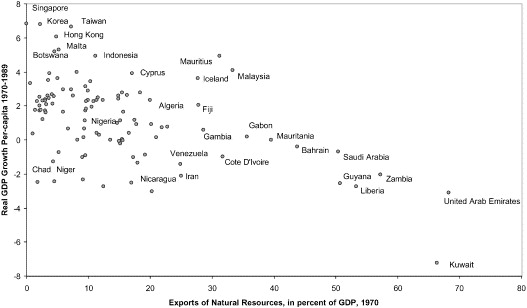
Numerous papers have been written on this negative correlation, including Jeffrey Sachs and Andrew Warner in 2001. In this paper the following graph is presented:


Figure 1: Growth and natural resource abundance (Sachs & Warner, 2001).

The graph presents the correlation between the export of natural resources as a percentage of the GDP in 1970 and the real economic growth per capita from 1970 to 1989 of the majority of the countries in the world. One can observe a negative trend in the dots that each represent a country, indicating that an increase of the export of natural resources results in a lower real economic growth. It is important to note that a lower growth rate is not the same as a negative growth rate. A lowering growth rate means that the economy is still growing but only using a lower percentage than previous. To me it is interesting to dig deeper in why this may or may not be a causal relation, because at first sight one may never believe that a natural resource might harm the growth of an economy.

First some reasons will be discussed on why this correlation may be a statistical delusion. I will try to argue why this is not the case for the Curse of the Natural Resources. After that I will try to work out three possible explanations: the Dutch disease, the governmental investments and corruption.

There is a possibility that the theory of the Natural Resource Curse, based on the visual representation of the data in the graph above, is in fact based on a fault correlation. First because it can be possible that there is a variable, different from export of natural resources and correlating negatively with economic growth just like the export. This may result in explanations based on the wrong variable and therefore wrong correlation. This statistical fault is called onmitted variable. A way to overcome this, is to control for previous growth rates and variables like climate and geography (Sachs & Warner, 2001). That is exactly what Sachs and Warner did in their statistical analysis that resulted in the graph above. So this will not hold against the statistical phenomenon and it explanations.
Another counterargument for the theory can be the fact that there is no distinction made between the different natural resources, because minerals have very different rents (higher) than agricultural products (Sachs & Warner, 2001). But the worldwide variation in natural resources is mainly caused by the mineral export of countries, so the inclusion of agricultural exports might even lower the observed deviation but in fact it does not alter the basic results from the statistical analysis (Sachs & Warner, 2001).
The final counterargument discussed in this blog is the reasoning that the currently richest countries in the world, used the resources from their colonies to achieve the wealth they experience nowadays (Sachs & Warner, 2001). Two points can be made against that reasoning. First is using the scarce historical data available, the resource intensity ratio until about the 20th century were much lower to ratios nowadays and are therefore incomparable (Sachs & Warner, 2001). Secondly, due to the strong global infrastructure network, relatively inexpensive energy necessary for the development of the industrial sector, cannot be considered to be a limiting for growth because transportation is fast and cheap (Sachs & Warner, 2001).

The first explanation for the correlation in Figure 1 is the Dutch Disease. The name for this phenomenon results from the time the natural gas fields in the north of the Netherlands were discovered (van der Ploeg, 2010). Other countries were interested in buying the Dutch gas, resulting in an increased demand for the Dutch currency, the Guilder (van der Ploeg, 2010). This appreciation resulted in a more expensive Guilder for foreign buyers (van der Ploeg, 2010). For buyers interested in the natural gas it was not considered to be a problem, but for buyers of other Dutch products that did not concern the natural gas (for example Dutch shoes called “klompen”), those products got relatively more expensive (van der Ploeg, 2010). This resulted in a decline of the export of Dutch manufactured products, so a decline of the growth of those sectors (van der Ploeg, 2010).
This story is not only applicable for the Dutch situation, because a situation of increased currency exchange due to discoveries of natural resources, resulting in a decline of the export of non-natural resource related sectors, can happen (and is happening) to other economies as well (van der Ploeg, 2010).  

The second explanation is based on less sustainable investments. Industries that concern the extraction of natural resources usually do not require high skilled employees and/or technologically advanced capital like the manufacturing and service sectors (Gylfason, 2001). Those two latter sectors result in higher sales and profits, resulting in higher economic growth and are therefore more beneficial for the evolution of society (Gylfason, 2001). Both are more sustainable in the lifetime of the capital, considered to be in this case knowledge or so-called “human capital”, compared to the capital of the extraction sector: the natural resource (Gylfason, 2001).
But the “easy-money” made with the natural resources on the short term results in investments and entrepreneurship in the extraction sector, instead of manufacturing and services (Gylfason, 2001). Therefore the economic growth of economies that have a relatively higher share of natural resources in the export is less compared to economies that are more focussed on pro-growth activities in manufacturing and services (Gylfason, 2001).

The third explanation has to do with so called “rent-seeking”. This is a form of activity that does not produce anything but tries to claim the wealth from goods that have weaker property rights, like natural resources (Marotta, 2013). Companies often lobby governments to get a benefit from some public policy, like taxing or spending (Marotta, 2013). Rent seeking does not entail positive social benefits and most of the time the overall effect is even negative (Scholtens, 2004). This phenomenon coheres with prestige projects that do not increase production and therefore social benefits (an example are golden cranes in governmental offices).
Governmental officials are temped for rent-seeking and corruption because profits from natural resources are high, concentrated and mostly easily appropriable (Sachs & Warner, 2001). This will contribute to less pro-growth activities and lower growth.
Research done by Auty (2000) points out the transfer from a development state to a predatory state when a new natural resource is discovered.

My personal thoughts on the theory on the Natural Resource Curse are maybe interesting too to conclude this article on my blog. I have done some research myself on whether the Dutch economy has truly suffered from the Curse. The results of that investigation were not reliable enough to make strong conclusions, but anyhow I believe it can be a good lesson for policy makers. Even though it is a correlation that has not got one outstanding explanation, it is important to take notice of it when the rules and policy around the extraction are created in any country. For example, it will never be harmfull to invest the short term profits made from the extraction, in longer term capital like education and infrastructure. Because whether or not a governmental officer is convinced of the legitimicy of this theory, the improvement of education and infrastructure will increase the personal benefits of every individual in the concerning economy. 


References

Auty, R. M., 1994. Industrial policy reform in six large newly industrializing countries: The resource curse thesis. World Development, 22(1), pp. 11-26.

Gylfason, T., 2001. Natural resources, education and economic development. European Economic Review, Volume 45, pp. 847-859.

Marotta, D., 2013. Forbes. [Online]
Available at: http://www.forbes.com/sites/davidmarotta/2013/02/24/what-is-rent-seeking-behavior/
[Accessed 18 09 2014].

Sachs, J. D. & Warner, A. M., 2001. The curse of natural resources. European Economic Review, 45(4-6), pp. 827-838.

Scholtens, L., 2004. Aardgasbaten verstoren de economische ontwikkeling. Economische Statistische Berichten, 89(4431), p. 174.

van der Ploeg, F., 2010. Natural Resources: Curse or Blessing?. Oxford: s.n.