Explanations Industrial Ecology puzzle
The Industrial Ecology puzzle of my choice is
the Natural Resource Curse as described by Richard Auty for the first time (Auty, 1994) .
On the question whether a natural resource is beneficial or harmful to an
economy, one would intuitively answer that it is beneficial. The reasoning for
that is mostly that an natural resource is “free” to an economy, meaning that
it can be extracted within the country and can be sold for a relative high
price per unit. But when one investigates the answer to this question a little
further, one will actually find a negative correlation between natural
resources and economic growth.
Numerous papers have been written on this
negative correlation, including Jeffrey Sachs and Andrew Warner in 2001. In
this paper the following graph is presented:
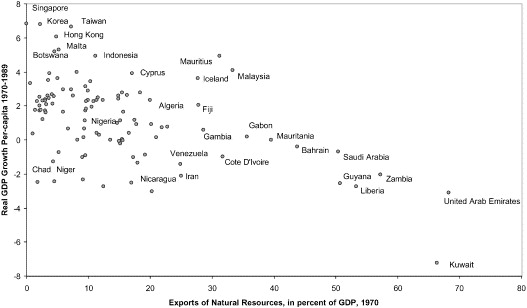
Figure 1: Growth and natural resource
abundance (Sachs & Warner, 2001) .
The graph presents the correlation between the
export of natural resources as a percentage of the GDP in 1970 and the real
economic growth per capita from 1970 to 1989 of the majority of the countries
in the world. One can observe a negative trend in the dots that each represent a
country, indicating that an increase of the export of natural resources results
in a lower real economic growth. It is important to note that a lower growth
rate is not the same as a negative growth rate. A lowering growth rate means
that the economy is still growing but only using a lower percentage than
previous. To me it is interesting to dig deeper in why this may or may not be a
causal relation, because at first sight one may never believe that a natural
resource might harm the growth of an economy.
First some reasons will be discussed on why
this correlation may be a statistical delusion. I will try to argue why this is
not the case for the Curse of the Natural Resources. After that I will try to work
out three possible explanations: the Dutch
disease, the governmental investments
and corruption.
There is a possibility that the theory of the
Natural Resource Curse, based on the visual representation of the data in the
graph above, is in fact based on a fault correlation. First because it can be
possible that there is a variable, different from export of natural resources and
correlating negatively with economic growth just like the export. This may
result in explanations based on the wrong variable and therefore wrong correlation.
This statistical fault is called onmitted
variable. A way to overcome this, is to control for previous growth rates and
variables like climate and geography (Sachs & Warner, 2001) . That is exactly
what Sachs and Warner did in their statistical analysis that resulted in the
graph above. So this will not hold against the statistical phenomenon and it
explanations.
Another counterargument for the theory can be
the fact that there is no distinction made between the different natural
resources, because minerals have very different rents (higher) than
agricultural products (Sachs & Warner, 2001) . But the worldwide variation
in natural resources is mainly caused by the mineral export of countries, so
the inclusion of agricultural exports might even lower the observed deviation
but in fact it does not alter the basic results from the statistical analysis (Sachs & Warner, 2001) .
The final counterargument discussed in this
blog is the reasoning that the currently richest countries in the world, used
the resources from their colonies to achieve the wealth they experience
nowadays (Sachs & Warner, 2001) . Two points can be
made against that reasoning. First is using the scarce historical data
available, the resource intensity ratio until about the 20th century
were much lower to ratios nowadays and are therefore incomparable (Sachs & Warner, 2001) . Secondly, due to
the strong global infrastructure network, relatively inexpensive energy
necessary for the development of the industrial sector, cannot be considered to
be a limiting for growth because transportation is fast and cheap (Sachs & Warner, 2001) .
The first explanation for the correlation in
Figure 1 is the Dutch Disease. The
name for this phenomenon results from the time the natural gas fields in the
north of the Netherlands were discovered (van der Ploeg, 2010) . Other countries
were interested in buying the Dutch gas, resulting in an increased demand for
the Dutch currency, the Guilder (van der Ploeg, 2010) . This appreciation resulted
in a more expensive Guilder for foreign buyers (van der Ploeg, 2010) . For buyers
interested in the natural gas it was not considered to be a problem, but for
buyers of other Dutch products that did not concern the natural gas (for example
Dutch shoes called “klompen”), those products got relatively more expensive (van der Ploeg, 2010) . This resulted in a
decline of the export of Dutch manufactured products, so a decline of the
growth of those sectors (van der Ploeg, 2010) .
This story is not only applicable for the Dutch
situation, because a situation of increased currency exchange due to
discoveries of natural resources, resulting in a decline of the export of
non-natural resource related sectors, can happen (and is happening) to other
economies as well (van der Ploeg, 2010) .
The second explanation is based on less
sustainable investments. Industries that concern the extraction of natural
resources usually do not require high skilled employees and/or technologically
advanced capital like the manufacturing and service sectors (Gylfason, 2001) . Those two latter sectors result in
higher sales and profits, resulting in higher economic growth and are therefore
more beneficial for the evolution of society (Gylfason, 2001) . Both are more
sustainable in the lifetime of the capital, considered to be in this case knowledge
or so-called “human capital”, compared to the capital of the extraction sector:
the natural resource (Gylfason, 2001) .
But the “easy-money” made with the natural
resources on the short term results in investments and entrepreneurship in the extraction
sector, instead of manufacturing and services (Gylfason, 2001) . Therefore the economic growth of
economies that have a relatively higher share of natural resources in the
export is less compared to economies that are more focussed on pro-growth
activities in manufacturing and services (Gylfason, 2001) .
The third explanation has to do with so called “rent-seeking”. This is a form of activity
that does not produce anything but tries to claim the wealth from goods that
have weaker property rights, like natural resources (Marotta, 2013) . Companies often
lobby governments to get a benefit from some public policy, like taxing or
spending (Marotta, 2013) . Rent seeking does
not entail positive social benefits and most of the time the overall effect is
even negative (Scholtens, 2004) . This phenomenon
coheres with prestige projects that do not increase production and therefore social
benefits (an example are golden cranes in governmental offices).
Governmental officials are temped for
rent-seeking and corruption because profits from natural resources are high, concentrated
and mostly easily appropriable (Sachs &
Warner, 2001) .
This will contribute to less pro-growth activities and lower growth.
Research done by Auty (2000) points out the transfer
from a development state to a predatory state when a new natural resource is
discovered.
My personal thoughts on the theory on the Natural Resource Curse are maybe interesting too to conclude this article on my blog. I have done some research myself on whether the Dutch economy has truly suffered from the Curse. The results of that investigation were not reliable enough to make strong conclusions, but anyhow I believe it can be a good lesson for policy makers. Even though it is a correlation that has not got one outstanding explanation, it is important to take notice of it when the rules and policy around the extraction are created in any country. For example, it will never be harmfull to invest the short term profits made from the extraction, in longer term capital like education and infrastructure. Because whether or not a governmental officer is convinced of the legitimicy of this theory, the improvement of education and infrastructure will increase the personal benefits of every individual in the concerning economy.
References
Auty,
R. M., 1994. Industrial policy reform in six large newly industrializing
countries: The resource curse thesis. World Development, 22(1), pp.
11-26.
Gylfason, T., 2001. Natural resources, education and
economic development. European Economic Review, Volume 45, pp. 847-859.
Marotta, D., 2013. Forbes. [Online]
Available at: http://www.forbes.com/sites/davidmarotta/2013/02/24/what-is-rent-seeking-behavior/
[Accessed 18 09 2014].
Available at: http://www.forbes.com/sites/davidmarotta/2013/02/24/what-is-rent-seeking-behavior/
[Accessed 18 09 2014].
Sachs, J. D. & Warner, A. M., 2001. The curse of
natural resources. European Economic Review, 45(4-6), pp. 827-838.
Scholtens, L., 2004. Aardgasbaten verstoren de
economische ontwikkeling. Economische Statistische Berichten, 89(4431),
p. 174.
van der Ploeg, F., 2010. Natural Resources: Curse
or Blessing?. Oxford: s.n.

A nice puzzle, interesting as well. I think its rather counterintuitive to think that the real GDP growth declines when the GDP consists of more export of natural resources. You might want to state your sources only at the end of a paragraph instead of every sentence. Reading the source everytime interferes a little with reading. However all these sources do show you've done your research! Other than that I find the article well structured, and it shows three plausible explanations for the Natural Resource Curse
BeantwoordenVerwijderenI’ve learnt a lot reading this blog! You seem to have done a lot of research and you found very plausible explanations for a puzzle that seemed inexplicable to me on first sight. It was also very interesting that you devoted a paragraph to all the counterarguments of the theory. One thing that I was curious about still, is the example of the ‘golden cranes in governmental offices’. Maybe you could have referred to a real example, because this example as a possibility seems a bit pulled out of the air to write down the first incredibly decadent thing that comes to mind. All well-structured, as Branco said. And even though it is a long blog post, it is not a drag to read at all, great post!
BeantwoordenVerwijderen